ST

Systems Synthesist · Berlin

SebastianThielke.

I build original frameworks from the intersection of domains most people keep separate: dentistry, rowing, nursing, LARP command, linguistics, and enterprise platform economics. The synthesis is the work.

11+
Domains synthesised
16
Original frameworks
15+
Fortune 500 clients
Who this is

Not a consultant. Not an advisor. A synthesist.

Most people who reach my work arrive through one thread: a framework, a Substack article, a LinkedIn post. And then notice the others do not fit neatly into the same drawer. That is intentional.

I have spent decades acquiring deep capability in domains that seem unrelated: the timing mechanics of rowing synchronization, the command structures of large-scale LARP events, the semantic drift patterns in Old and Middle English, the thermodynamics of enterprise scaling. Each domain contributed specific, transferable principles. The synthesis is the rare thing.

The result is a set of frameworks for how agentic systems, platforms, and organizations can be designed to reduce entropy rather than fight it. Built from lived experience at every level, not borrowed from existing literature. Where they came from →

The work

16 original frameworks. None borrowed from existing literature. Each emerged from a specific problem encountered in practice, resolved through cross-domain synthesis, and stress-tested against real organizational conditions.

01
Adaptive Mesh Ecosystem (AME)
A four-layer architecture: Foundation, Intelligence, Connectivity, Value Creation. For organizations where meaning is the prerequisite for agentic coordination, not an afterthought. The structural answer to why most AI deployments fail at scale.
02
Human in Meaning
A governance principle that rejects Human-in-the-Loop as insufficient. Meaning must be architecturally embedded before agents act. Not inserted as a checkpoint after. Replaces oversight theater with semantic grounding.
03
Adversarial Agent Stress Testing (AAST)
A two-pass pre-deployment methodology for multi-agent systems addressing technical, semantic, and structural failure categories. Built from analysis of real platform failures, not theoretical scenarios.
04
Adaptive Nodal Intelligence Mesh (ANIM)
The active executor layer within the AME Foundation. ANIM operationalizes meaning as a dynamic signal across agent nodes, enabling coordinated action without centralized control. The connective tissue of agentic deployment at scale.
05
Agent Deployability and Deployment Measurement
A structured evaluation framework that assesses whether an AI agent is genuinely ready for deployment and measures actual value generated post-launch. Separates readiness theater from operational reality.
06
Drift Detection
A methodology for identifying semantic, behavioral, and structural drift in agentic systems over time. Addresses the gap between what an agent was designed to do and what it actually does after extended deployment.
07
Human-Agent Organisation Architecture
Most organisations add agents to existing structures and wonder why nothing fundamentally changes. This architecture starts from a different premise. The organisation operates across three levels simultaneously: team, platform, and ecosystem, with agents woven in from the foundation up. Humans hold meaning. Augments maintain coherence against that meaning. Outcome-driven speed at scale.
08
Platform Economics Acceleration (PEA)
Built from zero. L100 to L300 certification pathways, multi-sided platform architecture, and ecosystem design applied across Fortune 500 clients in EMEA, APAC, and AMER.
09
The Fifth Participant
AI agents as a distinct participant type in platform economics: their own win condition, deployment value accumulation logic, and network effects. Distinct from the traditional four: producers, consumers, partners, orchestrators.
10
Disjunction Matrix
A structural analysis framework that makes the invisible visible in AI portfolios. Every initiative is mapped against six dimensions of the business. One column is almost always empty across every row. Not because the capability is absent, but because nobody commissioned the work. That column is the diagnosis. The gap between individual initiative quality and systemic portfolio outcome.
11
Launchpad
A structured acceleration framework for platform initiatives moving from concept to market. Defines the sequencing logic, stakeholder alignment, and minimum viable ecosystem conditions required for a platform to reach self-sustaining network effects.
12
Minimal Loveable Platform (MLPlat)
A platform cannot start with two participants. MLPlat defines the minimum viable starting condition: three participants, each interaction driven by a challenge, each challenge solved generating a product. Three products working in concert create the first transactions. Value flows across four dimensions: money, data, innovation, and collaboration. This is the missing logic in platform business creation. It is how you innovate, build, run, and scale a platform economy from the ground up.
13
End-to-End Capability Framework
A mapping of the full capability chain required to deliver platform value: from technical infrastructure through product, commercial, and ecosystem layers. Exposes the gaps organizations mistake for execution problems when they are architecture problems.
14
The Temporary Company
A model for organizations that scale through composable, temporary structures rather than permanent headcount accumulation. Informed by the thermodynamic principle that fighting entropy with entropy generates disorder.
15
Liquid Talent Deployment
A framework for matching capability to demand in real time across organizational boundaries. Treats talent as a flow rather than a stock, enabling organizations to respond to complexity without accumulating structural rigidity.
16
Enterprise Product Management Enablement
A capability-building system for product management in large organizations. Addresses the structural reasons enterprise PM fails: misaligned incentives, absent discovery discipline, and conflation of roadmap management with product leadership.
Latest from System Decoder
Loading latest article...
Latest from Medium
Loading latest article...
Writing

The Substack is where frameworks develop in public. LinkedIn is where they get tested against the people who disagree.

Substack · System Decoder
System Decoder
Active publication decoding agentic systems, platform economics, and organizational entropy. Frameworks developed in public. Arguments stress-tested against real organizational conditions.
Read → System Decoder
Framework
Human-Agent Organisation Architecture
Most organisations add agents to existing structures. The Human-Agent Organisation Architecture is what you build instead. A three-level operating system for outcome-driven speed at scale.
Speed without direction fills the bin faster. Direction without speed fills it with things nobody needed in time. Most organisations solve one and neglect the other. HAO is the architecture that runs both simultaneously.

HAO organises around three levels. The team is the operating unit. It crystallises around an outcome, activates when the viability conditions are met, and dissolves when the work is done. The platform is organisational memory. It retains what every team learns and makes it available to the next team before they start. The ecosystem is the compounding mechanism. Each build makes the next one faster and cheaper to validate.

Agents are not added to this system. They are woven into it as augments. Not tools. Not teammates. Extensions of human reach that maintain coherence against the meaning humans hold. ANIM routes signal without command and control. AME orchestrates participants without hierarchy. Human in Meaning keeps the whole system oriented toward what the work is actually for.
Read more
LinkedIn
Where frameworks meet pushback
Framework introductions, contrarian positions on AI governance, platform economics, and organizational design. The place where the ideas get stress-tested in public by people who disagree.
Follow → linkedin.com/in/sebastianthielke
Reach

If yourecognise the work.
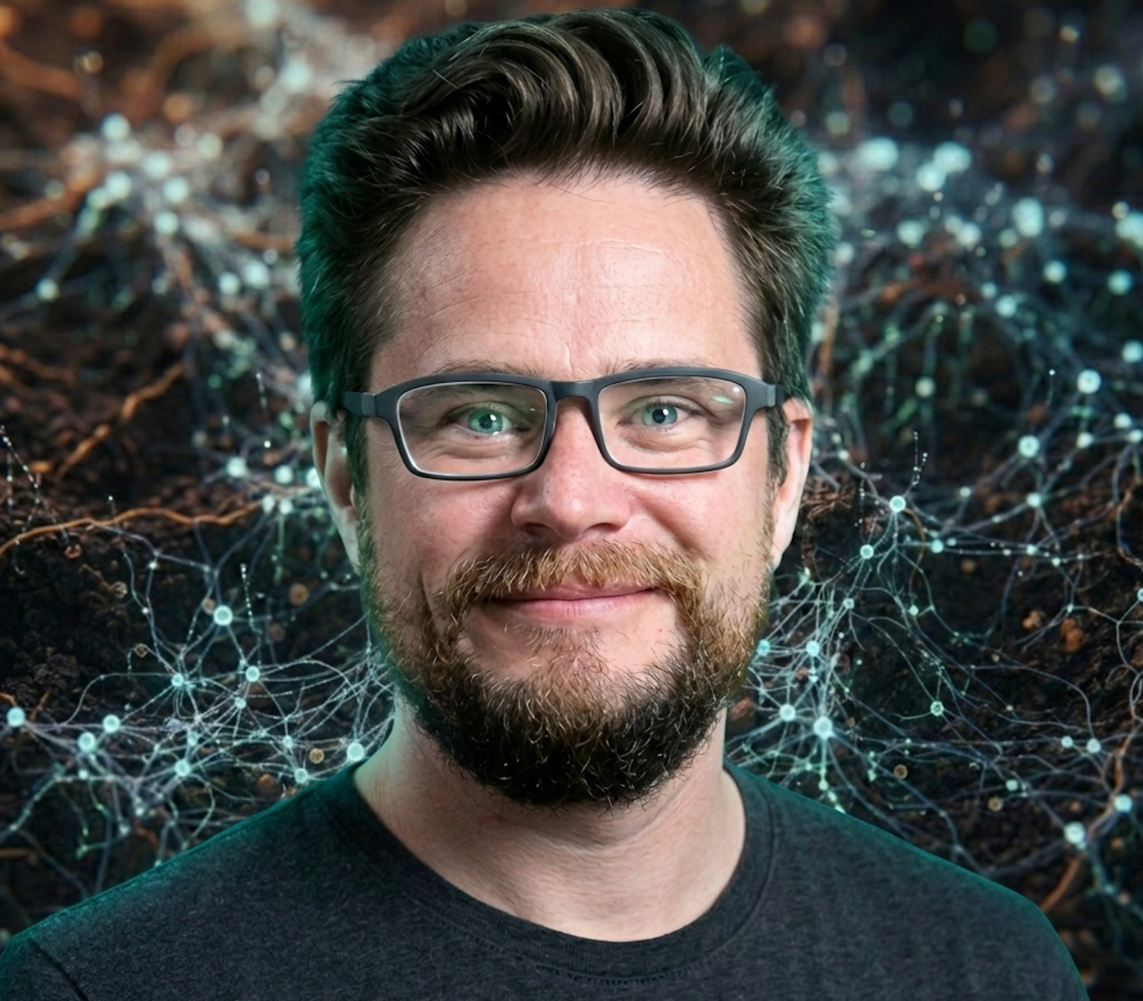
Sebastian Thielke

I am not difficult to find, but I am selective about where I spend conversation. If you have read enough to understand what is being built here and have something worth exchanging. Reach out.